
Abstract
Ibn Hazm, a theologian and a great scholar of Muslim Spain, born in a well-off family rose to eminence as a jurist of a great ingenuity, a historian, polemicist and a fine writer of prose and poetry. In his early years, he wrote a book Ṯauq-al Ḥamāmah (Neck-Ring of Dove), translated into many western languages, including a fine translation into English by Arthur Arberry (1905-1969). In his famous book Al-Milal-o-Al-Niḥal (The Book of Sects and Creeds), he propounded a theory of axiomatic knowledge as implicitly expressed in the behavior of children. This article deals mainly with his theory of innate knowledge. Some views of Allama Muhammad Iqbal (1877-1938) and Noam Chomsky (1928) have been deemed by the present writer as supportive of Ibn Hazm’s theory of axiomatic knowledge exhibited in children’s behavior. His magnum opus was voluminous Āl-Muḥalā (The Adorned Treatise) containing a wealth of juristic knowledge, unrivalled till date. He was in favor of state control over superfluous wealth and land, a view which after centuries, was extolled in Pakistan in late 1960’s.
Author(s):
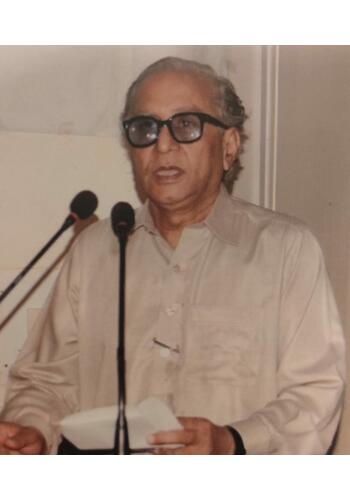
Dr. Aslam Ansari
Professor (R)Tamgha-i-Imtiaz, Poet, Critic, Researcher and Intellectual, Multan.
Pakistan
- dr_aslam_ansari@live.com
Details:
| Type: | Article |
| Volume: | 14 |
| Issue: | 1 |
| Language: | Urdu |
| Id: | 649485544fc66 |
| Published | June 22, 2023 |


This work is licensed under a Creative Commons Attribution-NonCommercial-NoDerivatives 4.0 International License.